


Page 30 - Undergraduate Research Opportunities Program Proceedings 2017-18
P. 30
School of Science
           Department of Mathematics

           Department of Mathematics


           Low-Rank and Sparsity Reconstruction in Data Science

           Supervisor:       CAI Jianfeng / MATH                   Co-Supervisor:   YE Guibo / MATH
           Student:          JIANG Bo / MATH-SFM                   Course:         UROP1100, Fall
                             ZHOU Weixuan / ECOF                                   UROP1100, Fall

           This paper tends to provide a brief analysis and some implementations of a popular algorithm in object detection,
           namely, max-margin object detection (MMOD). To introduce this algorithm, a quick review of Platt’s fast training of
           support vector machines (SVM) using sequential minimal optimization (SMO) will be provided. Some background
           knowledge in Histograms of Oriented Gradients (HOG) and Convolutional Neural Network (CNN) will also be discussed.
           Then this paper will analyze the main algorithms of MMOD and, using the publicly available library, implement the
           algorithms and display the main results visually. Our results show that MMOD generally works well in avoiding false-
           alarm, while there is still room for improvement in missed detections.


           Combinatorial Studies of Gauss-Bonnet and Hopf Theorems
           Supervisor:       CHEN Beifang / MATH
           Student:          WAN Jingbo / MATH-IRE                 Course:         UROP1100, Spring

           This report focus on the classical Poincare-hopf theorem for vector field on 2-dim manifold and its generalization on
           directed graph. The classical Poincare-hopf theorem is a theorem concerning the relation between isolated zeros of
           smooth vector field and the topology of the smooth 2-manifold. Is is very surprise that the sum of index of any vector
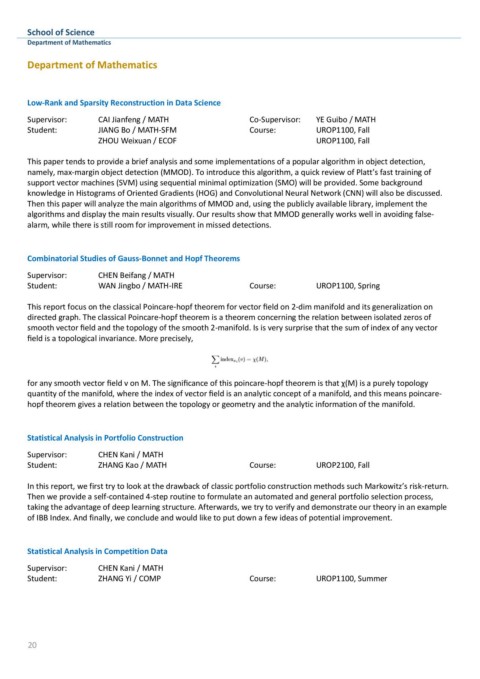
           field is a topological invariance. More precisely,


           for any smooth vector field v on M. The significance of this poincare-hopf theorem is that χ(M) is a purely topology
           quantity of the manifold, where the index of vector field is an analytic concept of a manifold, and this means poincare-
           hopf theorem gives a relation between the topology or geometry and the analytic information of the manifold.


           Statistical Analysis in Portfolio Construction

           Supervisor:       CHEN Kani / MATH
           Student:          ZHANG Kao / MATH                      Course:         UROP2100, Fall

           In this report, we first try to look at the drawback of classic portfolio construction methods such Markowitz’s risk-return.
           Then we provide a self-contained 4-step routine to formulate an automated and general portfolio selection process,
           taking the advantage of deep learning structure. Afterwards, we try to verify and demonstrate our theory in an example
           of IBB Index. And finally, we conclude and would like to put down a few ideas of potential improvement.


           Statistical Analysis in Competition Data

           Supervisor:       CHEN Kani / MATH
           Student:          ZHANG Yi / COMP                       Course:         UROP1100, Summer


           20

