the HKUST put in place in recent years.
The university also instigated research
on sustainable development in northwest
China. In 2012, HKUST became the first
partner in Asia of online education platform
Coursera and the first institution in Greater
China to offer Massive Open Online Courses
(MOOCs).
Amidst the intensifying dialogue on how the
emergence of online learning would impact
the traditional education, Professor Shyy
said that HKUST introduced MOOCs not
just to digitize the course materials, but to
improve the quality of teaching and learning
inside the HKUST classrooms to a larger
extent.
Sounds a bit paradoxical, doesn’t it?
Professor Shyy explains, the biggest
advantage of MOOCs is that it gives
institutions access to a huge volume of data
about teacher-student interactions. In fact,
professors from the HKUST Department of
Computer Science and Engineering made
this a research subject. They designed
research tools to analyze students’ learning
patterns, such as the learning areas that
are most and least interesting. “With these
data and research results, educators can
improve their course design. I find this a very
important reason for rolling out MOOCs on
our campus.”
Professor Shyy took the view that MOOCs
would not replace traditional classroom
education. “University education is not just
about knowledge acquisition. It is also about
the campus life, faculty-student interaction,
and gaining a variety of experiential learning
experiences, etc.” he said. Technology will
facilitate, not dominate the educational
processes and outcome.
Globalization is a trend. In terms of the
degree of campus globalization, HKUST has
surpassed other universities in the region.
“About 50 percent of our undergraduate
students go on overseas exchange for a
semester. And we are actively promoting
exchange between our local and non-local
students right on our campus. We want
our students to become global citizens by
exposing them to different cultures as early
as possible.”
HKUST’s distinctive culture
“Great universities would have not just great
hardware, resources and abundant funds,
but the confidence, qualities and culture.”
HKUST is celebrating its 25th anniversary
this year. Professor Shyy believes that energy
and drive have been the keys to putting the
relatively young HKUST among the ranks of
the world’s top universities in such a short
time. “The distinctive culture slowly brewing
and taking shape on our campus is constant
exploration and innovation,” he said.
To all students, Professor Shyy offers the
following food for thought: The four years of
the university are a very precious part of the
lifetime. The HKUST offers ample freedom,
space and opportunity for students to find
their purpose. Make the most of it, keep
trying, and build confidence!
Aerospace Engineering in Hong Kong
Professor Shyy joined the HKUST in 2010.
Thinking back when he first landed in Hong
Kong, a colleague told him that there were
no birds to watch in Hong Kong, he smiled
and said, “there are many birds which may
just go unnoticed.”
Professor Shyy is an expert in aerospace
engineering. Back in 2010, the university
didn’t offer program or course on aerospace
engineering. It did, however, have an
aeronautics interest group with nearly one
hundred zealous students. In 2012, a
team of HKUST students even won second
place in the Global Trajectory Optimisation
Competition. “That’s when we knew we had
to start the aeronautics program. Students’
demand was definitely there.”
In 2012, the HKUST officially launched a
minor program in Aeronautical Engineering,
covering courses on aircraft design
and aerospace system management.
In 2014, five students in the Mechanical
and Aerospace Engineering program
won second place in the National Aircraft
Design Competition in China. HKUST
officially launched the BEng in Aerospace
Engineering degree program in Year
2015/16.
Aeronautical development in Hong Kong is
no longer a far fetched dream. The program
has become an attraction for many talented
young people in choosing to study at HKUST.
Globalized tertiary education
The BEng program in Aerospace Engineering
is just one in a string of new initiatives
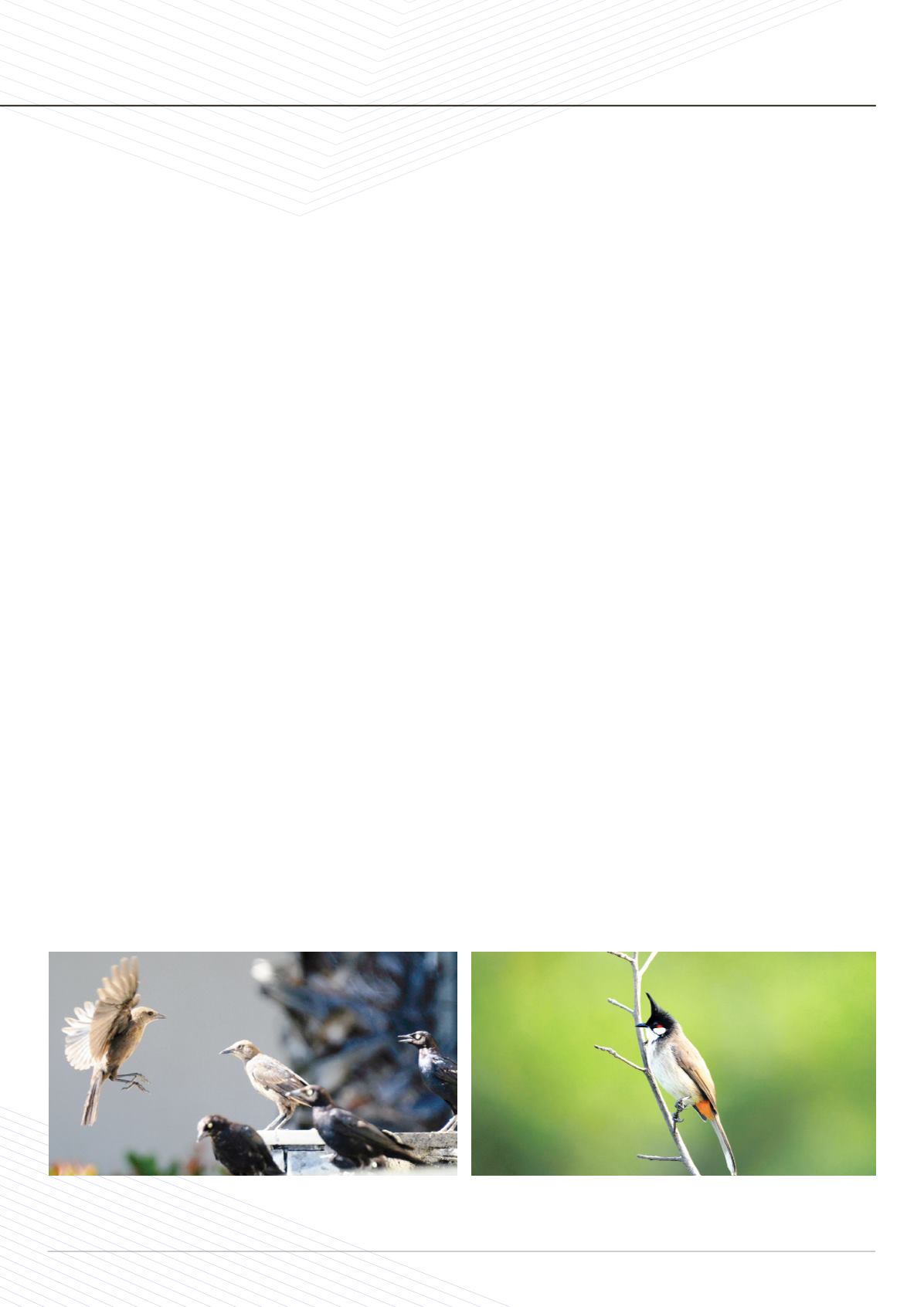
Photos from Prof Shyy’s photo album “Flight InSight”
A bird’s-eye view on education, from a bird watcher
03
2015


