undergraduate students in Hong Kong. The
program provides a platform for HKUST
professors to guide undergraduate students
in developing their own research studies.
For Sean, this was a very different research
experience compared to the iGEM. Sean’s
research project dealt with the treatment
of dry eye syndrome. Not limited by his
major in biology, Sean’s research study
included elements of chemistry and optics,
and he also procured and developed
research tools and equipment for the lab.
His main accomplishment in the program
was manufacturing fluorescence-tagged
hyaluronan polymers for use as indicators
for ocular surface retention and tear film
stability. “UROP helped me understand
that I have the ability to advance my own
research projects. It gave me a great boost
of confidence,” he said.
In recognition of his outstanding research
performance, the HKUST nominated Sean
to the International Research Opportunities
Program (IROP) in 2014. The program
allows exceptional HKUST students
to conduct research projects at world-
renowned institutions including MIT, the
Tokyo University of Technology, Cambridge
University, and the CERN. Sean was
assigned to two research projects at MIT,
focusing respectively on microbiological
sensors for water contaminants and for
markers of digestive tract disease. In the
From Bachelor direct to PhD: It can be done!
first project, Sean and his team constructed,
through genetic modification, bacteria
that can detect mercury, lead and arsenic
in water. A breakthrough was achieved
in the second project—while under an
MIT graduate student’s advisorship, Sean
engineered glowing bacteria that can
detect bleeding in the digestive tract. The
project could have implications in diagnostic
medical testing, as the technology has
potential to surpass existing endoscope
technology in terms of patient compliance
and safety.
“What iGEM, UROP and IROP helped
me realize is that I, too, can do well and
make meaningful contributions. I can
make a positive impact on the world by
helping medical patients in need. That
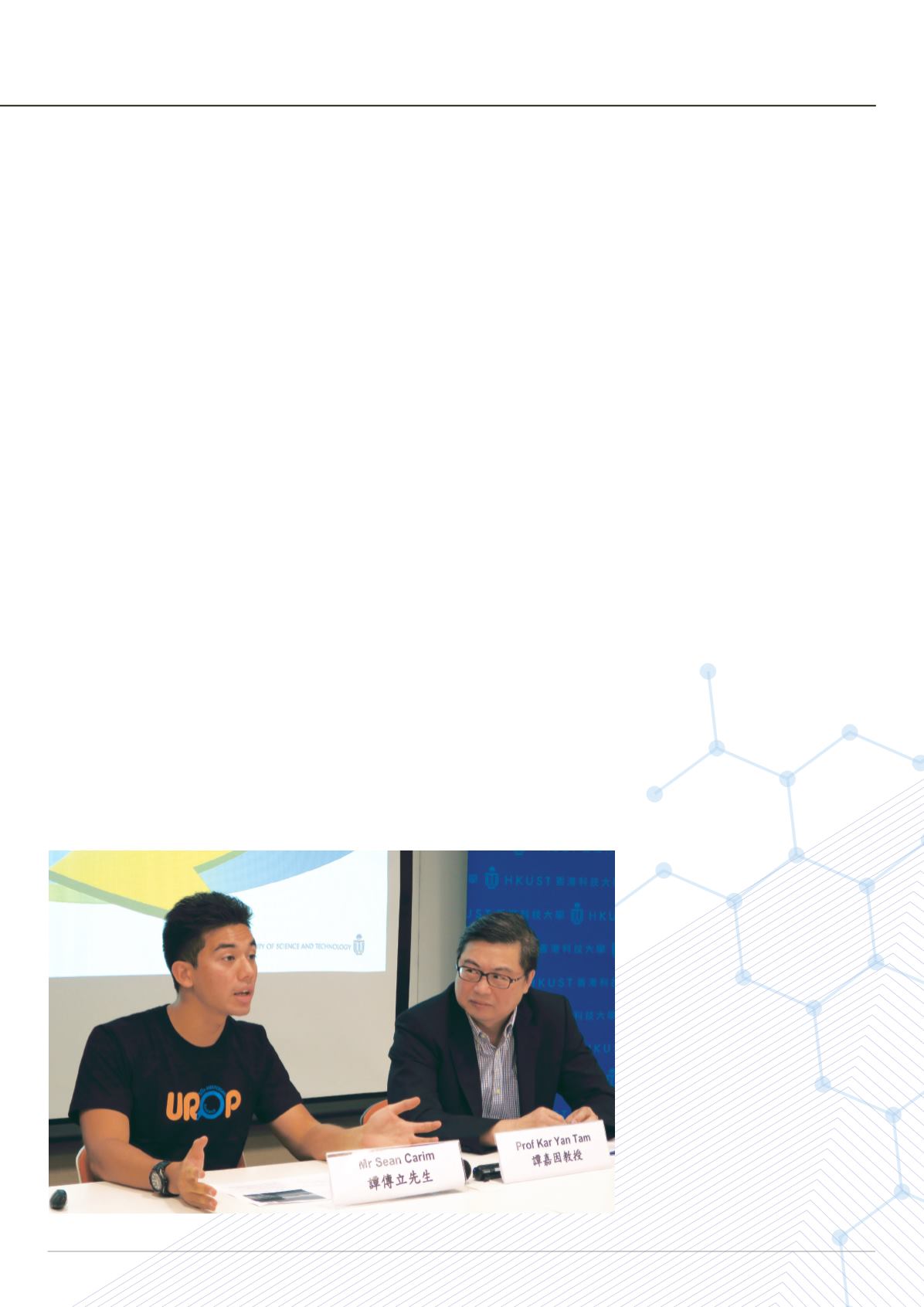
feels great.” Sean said at a media interview
earlier this year. With such solid biological
research experience under his belt, Sean
has been accepted into a PhD program
at UC Berkeley, where he will advance
his studies in microbiology and conduct
further research on bacterial solutions to
environmental pollution issues. He will start
this August.
Sean’s success was no coincidence – as
in many cases, Sean’s example proves
that only people who pursue larger-than-
life goals can create their own big break.
Sean was never one to bury himself in a
lab. Since secondary school, Sean had
given himself to humanitarian initiatives
around the world, transforming agricultural
waste into charcoal fuel in mainland China,
educating Cambodian children about
illegal human trafficking and taking part in
earthquake relief efforts. These experiences
helped Sean recognize, with much greater
clarity, his dedication to improving the
environment. More significantly, Sean’s
efforts in the humanitarian arena won him
scholarships from The Croucher Foundation
and the National Science Foundation.
Of his four years at the HKUST, Sean said: “I
made many friends, learned a lot outside the
classroom, familiarized myself with state-of-
the-art science laboratories and became
more aware of biology subfields that most
interest me. But most importantly, I gained
confidence.”
“In a way, my experiences are similar to
those of my classmates who pursued
corporate internships. I just had the
invaluable opportunity to work in some of
the best labs in the world.”
Proactive, courageous and determined
students like Sean are everywhere on the
HKUST campus. The university offers a
plethora of opportunities for students with
drive and aspiration to discover their paths
and realize their dreams.
05
2015


