By Sunjung Lim
林宣廷
people and may potentially cause another SARS-
like epidemic in China in the future [1].
Although scientists have suspected bats as
a source of coronaviruses, the virus responsible
for SARS, they were unable to prove how the
infection passed from these nocturnal animals to
humans for many years. Thus, in order to learn
more about the SARS virus, Chinese researchers
obtained genetic samples from horseshoe bats
in Kunming. Together with researchers from
Australia, Singapore and the United States, the
team identified at least seven different strains
of a SARS-like coronavirus [2]. Two of the strains
closely resembled the SARS strain, especially
for the genes encoding the impor tant spike
proteins. Fur thermore, di rect bat-to-human
transmission is feasible since the SARS virus is able
to bind directly to protein receptors (angiotensin
converting enzyme II or ACE2) on human cells.
It suggests that SARS viruses do not need to be
transfer red to another host before infecting
humans.
In
November 2002, a lethal strain of virus
arose in southern China. In less than a year,
the ter r if ying pandemic disease, known as
Severe Acute Respiratory Syndrome (SARS), had
spread over thir ty-three countries, affecting
more than 8,000 people and killing more than
700 worldwide. Hong Kong was no exception
and the lively city was covered by a shroud of
nightmare from March to June 2003. All activities
in schools and higher institutions were suspended
during the course of the pandemic and reports
on the number of newly infected and deceased
cases increased daily on the news.
It has been a decade since, and scientists
have discovered that the host animal of the SARS
virus is a civet, a nocturnal cat-like mammal
belonging to the taxonomical family Viverridae.
Recently, however, researchers have isolated a
closely related virus from bats in China that can
infect human cells. According to one of the
lead researchers Peter Daszak, this discovery is
significant because it demonstrates that there
are bats carrying the virus that can directly infect
Stay Away From
Bats!
遠離蝙蝠
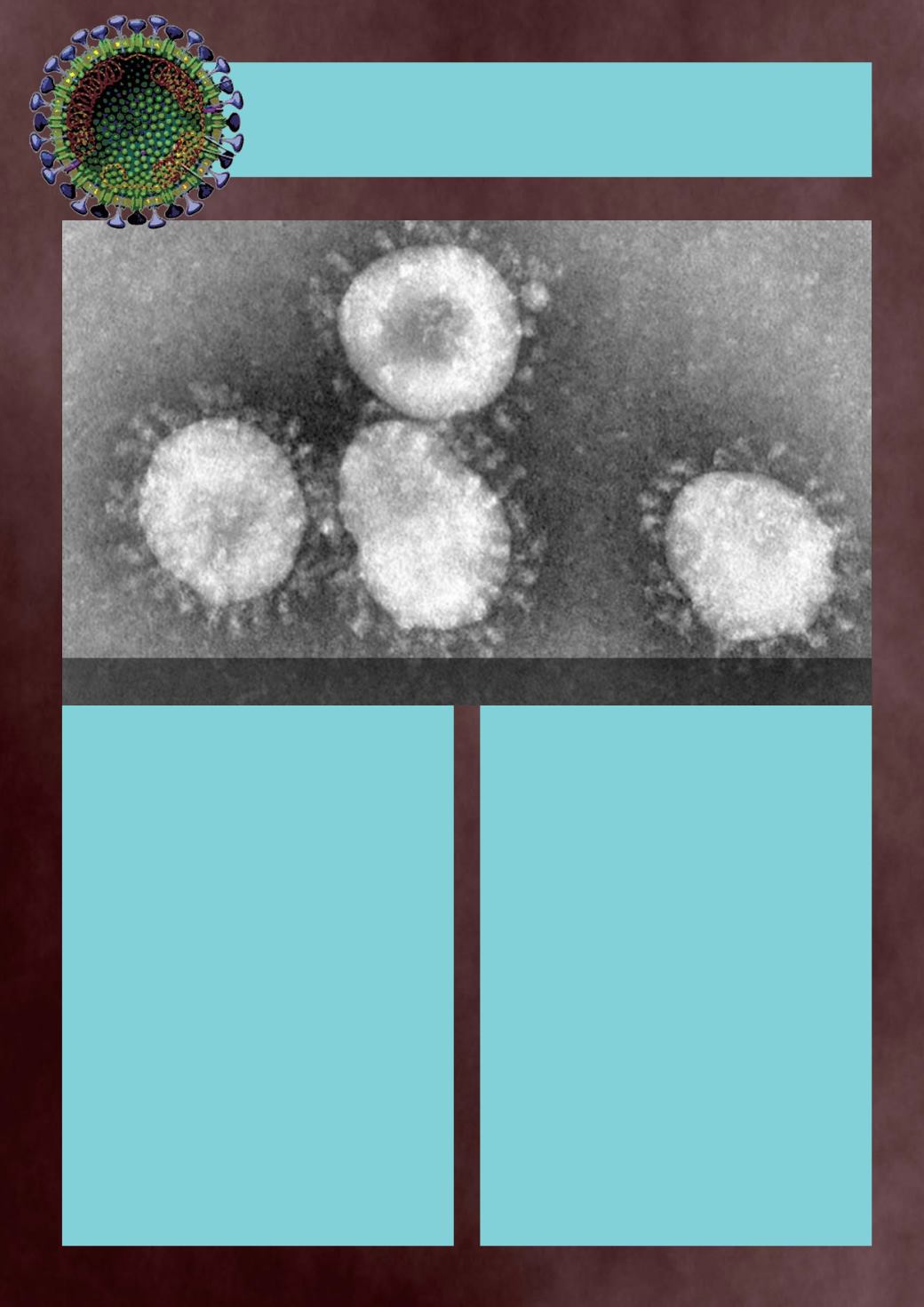
Micrograph of coronavirus, with a halo-like appearance. Photo courtesy of Frederick A. Murphy
顯微鏡照片中的冠狀病毒呈光環形狀。照片由
Frederick A. Murphy
提供


