References
[1] Leshin, Laurie (2013) Crater, Mars Soil
Diversity and Hydration as Observed by
ChemCam at Gale, Science
[2] Stopler, E. M. et al. (2013) The
Petrochemistry of Jake_M: A
Martian Mugearite, Science
Red Planet: A Hidden Sponge
Mars
, named after the Roman God of
War is, approximately, 56 million km away from
Earth, making it our second closest neighbor (Venus,
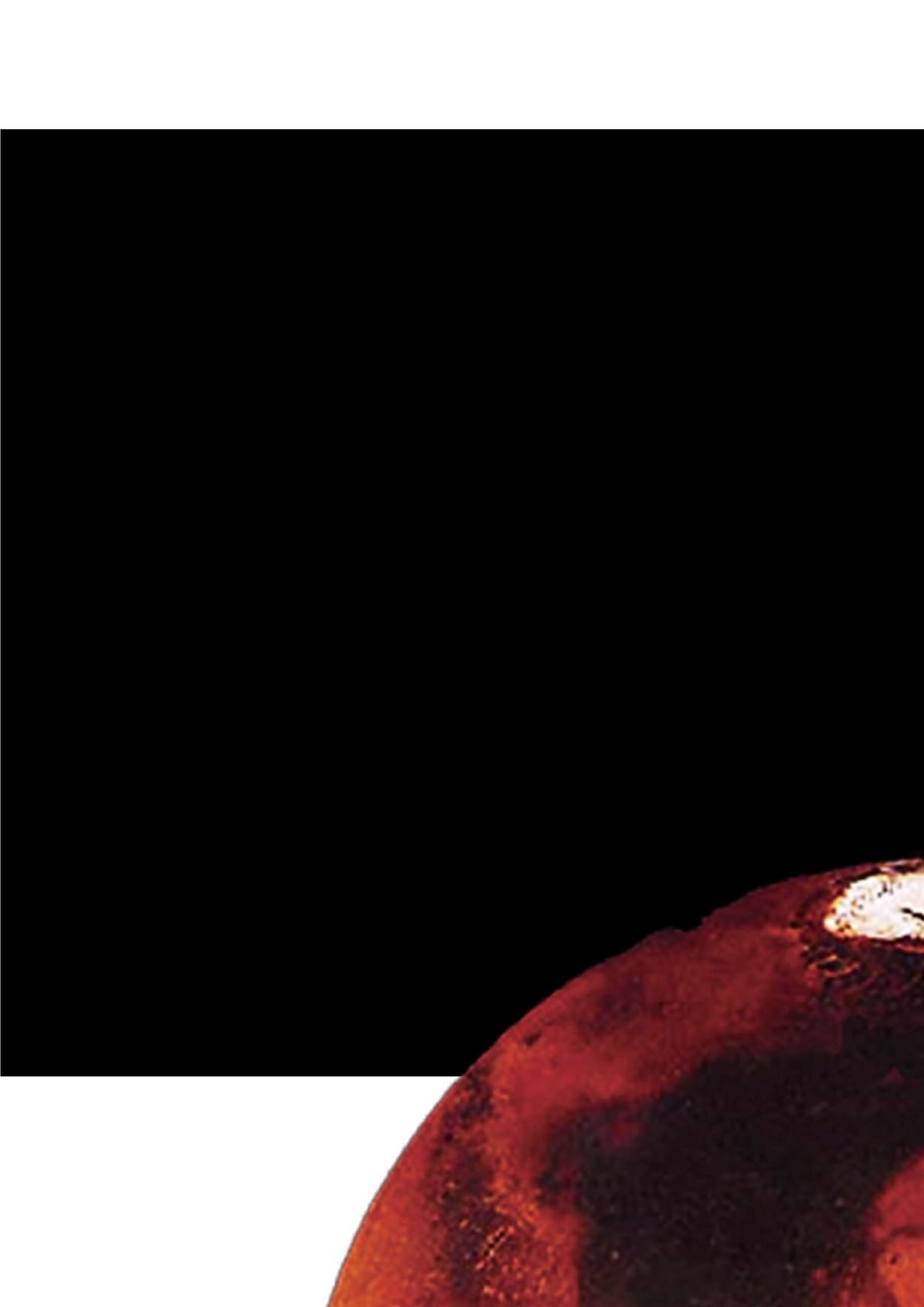
being the closest). The Red Planet is covered with
iron-rich soil and resembles Earth in various ways.
For instance, it is enwrapped by a thin atmosphere,
and has polar ice caps, volcanoes, and seasonal
cycles. These resemblances draw a deeper curiosity
to reveal the secrets and potential of life on this
mysterious planet.
In November 2011, NASA-developed robotic
rover Curiosity was launched into space from Cape
Canaveral, USA to explore ‘Gale’, a crater on
Mars. It shouldered a mission to investigate Martian
climate and geology, as well as environmental
conditions favorable for life. Since landing in
August 2012, Curiosity has sent pictures and data of
Mars back to Earth, where leading scientists have
analyzed and revealed exciting evidence of the
presence of water in Martian soil.
Laurie Leshin, Dean of Science from Rensselaer
Polytechnic Institute at New York and her team
discovered solid carbonated minerals in Martian
soil that imply a presence of water [1]. Another
researcher E.M. Stopler also suggested the presence
of water in Martian soil by finding Jake Matijevic (or
Jake M), a type of rock named after the engineer
contributing to the Curiosity project. Stopler and his
team found striking resemblances between Jake
M and mugearite, a type of rock found on rifts and
islands on Earth that forms from magma, crystallized
with 1-2% water [2]. This similarity implies that Jake M
is likely to form only where water is present.
Yet the pursuit of the presence of life forms on
Mars brings up the definition of “life” itself.
This is not a straightforward question to tackle.
The definition of life is continually explored in
philosophy as much as it is in science. Ancient Greek
philosopher Aristotle perceived life as an irreducible
fact of the natural world. 1800s German philosopher
Immanuel Kant viewed life as an organization. With
the rise of biochemistry and molecular biology in
the twentieth century, Cambridge scientists like
Sir Frederick Gowland Hopkins viewed life from
a cellular level as a collection of physical and
biochemical processes. Simply put, a single cell is a
unit of life.
A normal cell is anywhere between 60% to 75%
water. Water is essential for biochemical functions,
including being the final electron recipient of
glucose metabolism that provides ATP or energy for
living organisms to function. It is ideal in its ability of
remain liquid over a wide range temperatures and
its property in having a high specific heat capacity
means that higher energy input (or heat) is required
to change a given amount of water. The variation of
the surrounding temperature would therefore have
less of an impact on the change in temperature
of water, making it a favorable environment for
marine life as well as stabilized temperatures for
cellular activity. The role of water in sustaining life as
we know it on Earth is vitally important.
The discover y of the potential presence of
water on Mars is exciting news as this suggests the
potential for the Red Planet to harbor life forms
similar to that of Earth. However, if Mars were a
book, our current knowledge of this mysterious
planet would barely fill up the first page. Scientists
are currently investigating the presence of life on
Mars based on the understanding of life from Earth.
Yet some scientists like Norman Wingate Pirie hold
the opinion that life is too complicated to confine
to a list of processes. For now, the discovery of
water on Mars holds exciting implications, but
perhaps, ‘life’ on Mars has nothing to do with
what we are familiar with on Earth, and is instead
propelled by substances otherwise thought
impossible to sustain l ife. Future
resea rch and exp l o rat i on
could in fact surprise us
all by completely
redefining life
itself.


