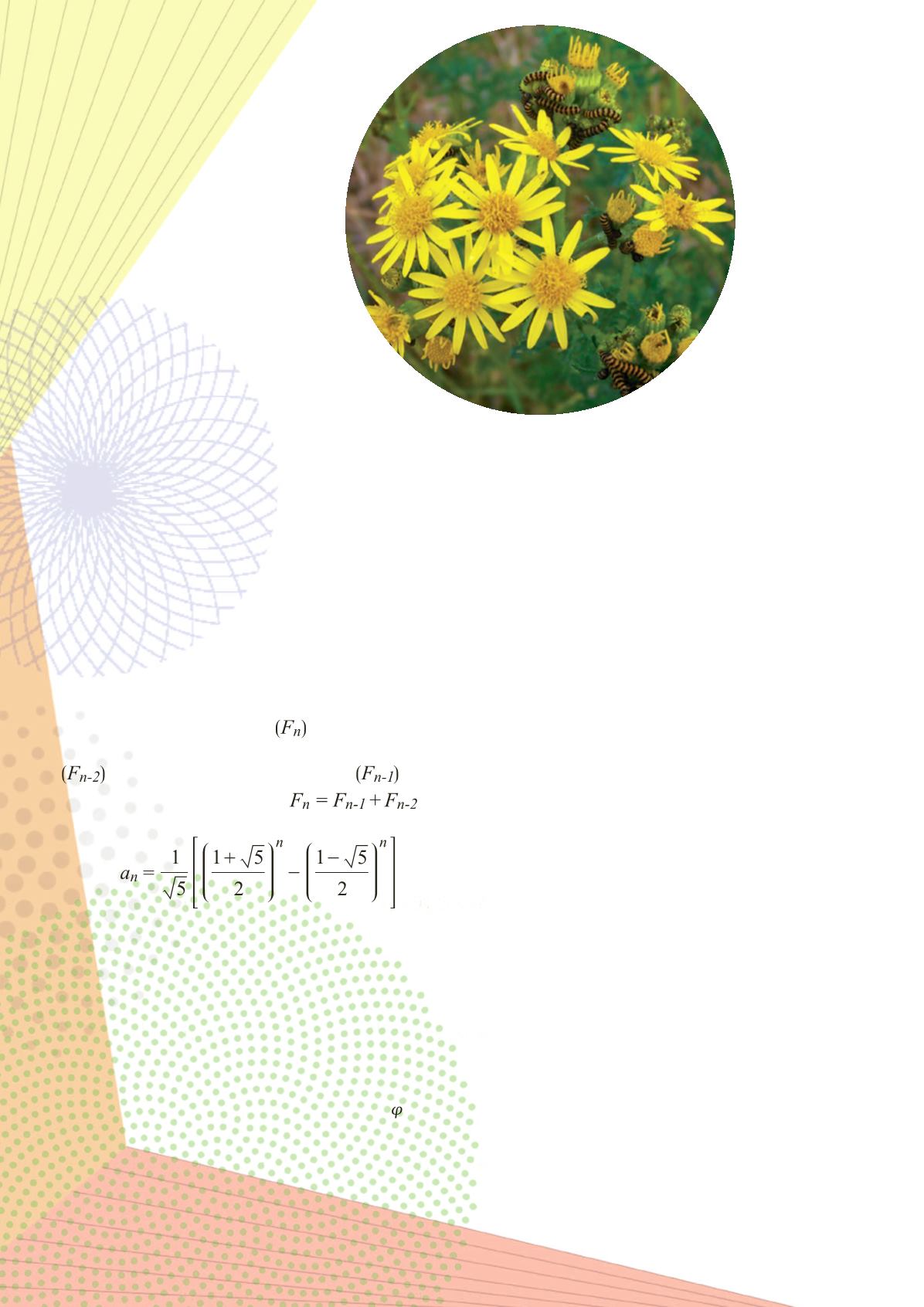
13 petal ragwort.
Photography credits to
Trish Steel.
Picture
a model of
immortal female and male rabbits
that are only able to reproduce
one female and one male rabbit
at one time. A month into their lives
they will be able to mate. At the end
of the second month, they will give
birth to a new pair of immortal rabbits
with the same reproduction limitations. Now
there are two pairs of rabbits. The new rabbits also
mate a month after they are born; meanwhile the
old pair gives birth to a new pair of rabbits for a
total of three pairs of rabbits. With me so far? In
other words, the number of pairs of rabbits is now 0,
1, 1, 2, 3 and in the next month, 5. How many pairs
of rabbits will there be in the month after? How
many pairs will there be in a year? These were
questions posed by the Italian mathematician,
Leonardo Fibonacci, in the 13th century.
On cl oser i nspect i on, each new term i s
determi ned f rom summi ng the cur rent and
previous term. At the end of the nth month, the
total number of rabbit pairs
is equal to the sum
of the number of rabbit pairs in the previous month
and the new-born rabbit pairs
. As an
equation, this is expressed as
with
the general term for the Fibonacci sequence as
Let’s take this a step further. When we divide
two sequential Fibonacci numbers, we obtain a
series like so:
1/1 = 1, 2/1=2, 3/2=1.5, 5/3=1.666..., 8/5 = 1.6,
13/8 = 1.625 etc.
This results in a new series of numbers that
converge into what we call the ‘Golden ratio’,
~1.618034, represented by the Greek letter (phi).
What is more interesting is that the numbers
of the Fibonacci sequence frequently appear
in nature, which is related to its proper ty of
converging to the Golden ratio. For example,
many types of flowers exhibit numbers of petals
that belong to the Fibonacci sequence. The
ragwort, for example, has 13 petals and daisies
with 13, 21, 34 or 55 petals are commonly found.
Another famous example of Fibonacci numbers
seen in plants is the arrangement of seeds in
sunflowers, which possess either 34 levo-spirals or
21 dextro-spirals.
While no explanations fully backed by scientific
evidence exist, some experts have suggested that
plants adopt the Fibonacci arrangement in order
to better utilise limited space for a higher chance
of producing more progenies. The number of
petals is decided based on the size of the flower
disc to produce as many petals as possible to
attract pollinating insects. Similarly, spirals in
sunflowers allow the maximum number of seeds
available for propagation.
Human beings may not be exempt from this
ratio either. Some studies have shown that phi
is intimately connected to how we perceive
aesthetics. Test subjects were asked to rate
the attractiveness of random faces. The results
indicated that the faces which received the
highest ratings were ones that exhibited ratios
between the width of the face and the width
of the eyes, eyebrows and nose, closest to the
Golden ratio. In fact, the Golden ratio may be
present even on molecular levels. A full cycle of a
molecule of DNA is approximately 34 angstroms
long and 21 angstroms wide. A coincidence?
Tel l us what you think by e-mai l ing us at
Can you find more examples
of the Fibonacci sequence or the Golden ratio in
nature?


